
What mAh and watt-hours actually measure
AI-generated generic editorial illustration — not a retailer product photo and does not depict the reviewed product or service. Editorial illustration supporting this section.
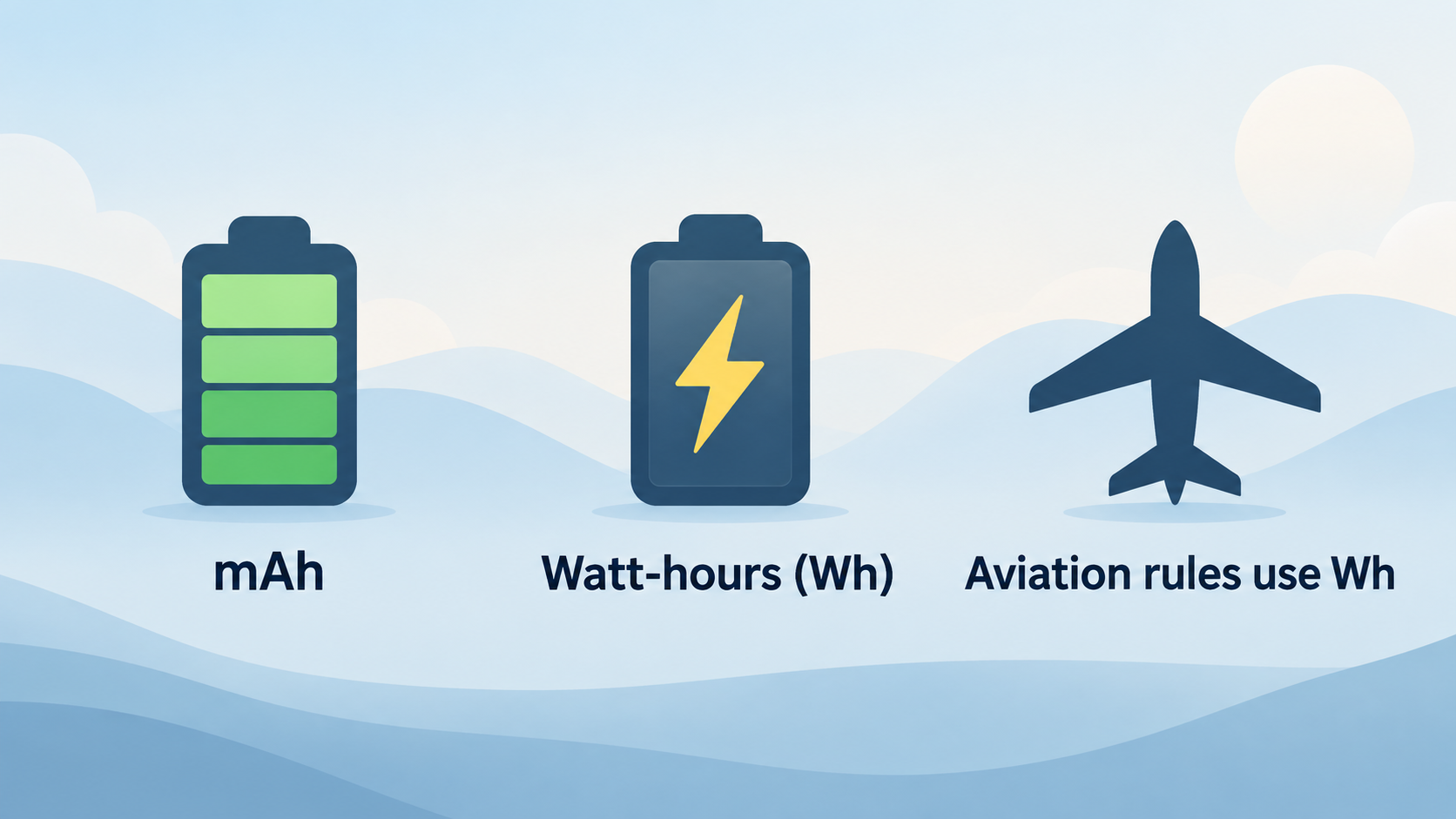
A power bank box usually leads with a big number in mAh. That figure is milliamp hours, a measure of electrical charge. Watt-hours (Wh) measure energy, which is charge combined with voltage. Because two batteries can hold the same mAh at different voltages, Wh is the fairer yardstick when you compare products. These unit definitions are standard physics and arithmetic rather than something drawn from a single quoted source.
Belkin describes 10,000 and 20,000mAh as the most common power bank sizes, so most buying decisions come down to those two tiers. The mAh number still has a use: it lets you see at a glance which size band a product sits in. It just cannot tell you the whole story on its own.
Watt-hours matter most when you travel. IATA says lithium batteries can be carried by air depending on configuration and Watt-hour rating for rechargeable batteries. The rules are framed around Wh, not mAh. If a power bank only lists mAh, you will need to convert before you can compare it with an aviation limit.
The rest of this guide shows how to do that conversion, why your phone will not receive the full label capacity, how to match capacity and output to your devices, and where to check the current airline rules.
Converting mAh to watt-hours step by step
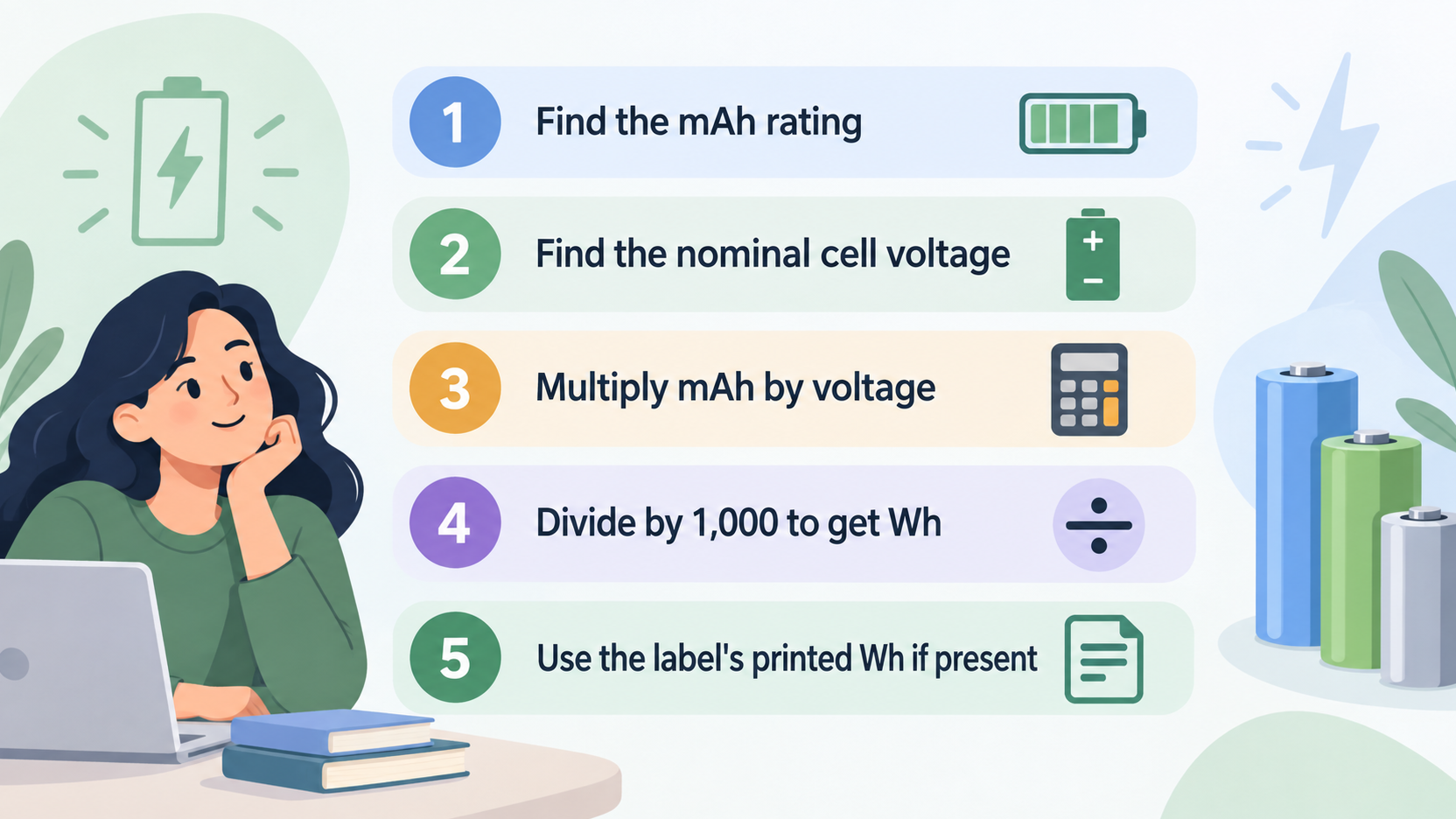
AI-generated generic editorial illustration — not a retailer product photo and does not depict the reviewed product or service. Numbered checklist of the conversion steps the section states, ending with the reminder to prefer the printed Wh.
The formula is simple:
Wh = mAh × nominal cell voltage ÷ 1,000
- Find the mAh rating on the label or spec page.
- Find the nominal cell voltage. Lithium-ion cells are commonly described as roughly 3.6–3.7V nominal. That is a general convention, not a figure taken from the manufacturer pages we reviewed, so treat it as an estimate.
- Multiply mAh by the voltage.
- Divide by 1,000 to get Wh.
- If the product prints a Wh figure, use that instead of your own calculation.
Two worked examples, using 3.7V as the assumed voltage:
- A 10,000mAh power bank: 10,000 × 3.7 ÷ 1,000 = 37Wh.
- A 20,000mAh power bank: 20,000 × 3.7 ÷ 1,000 = 74Wh.
Using 3.6V instead gives 36Wh and 72Wh, so the answer shifts slightly depending on the voltage assumed. These are illustrations of the arithmetic, not the rated figures for any specific branded product.
The voltage matters because the cell voltage is not the same as the 5V or higher that a USB port delivers. If you multiplied the mAh figure by the USB output voltage, you would overstate the stored energy. That is one reason mAh figures on boxes can mislead when you compare them with a phone's own battery rating or with an airline limit.
When a manufacturer prints Wh on the product or its spec page, prefer that number. It reflects the maker's own rating rather than a rule-of-thumb voltage.
Why real phone charges fall short of the label
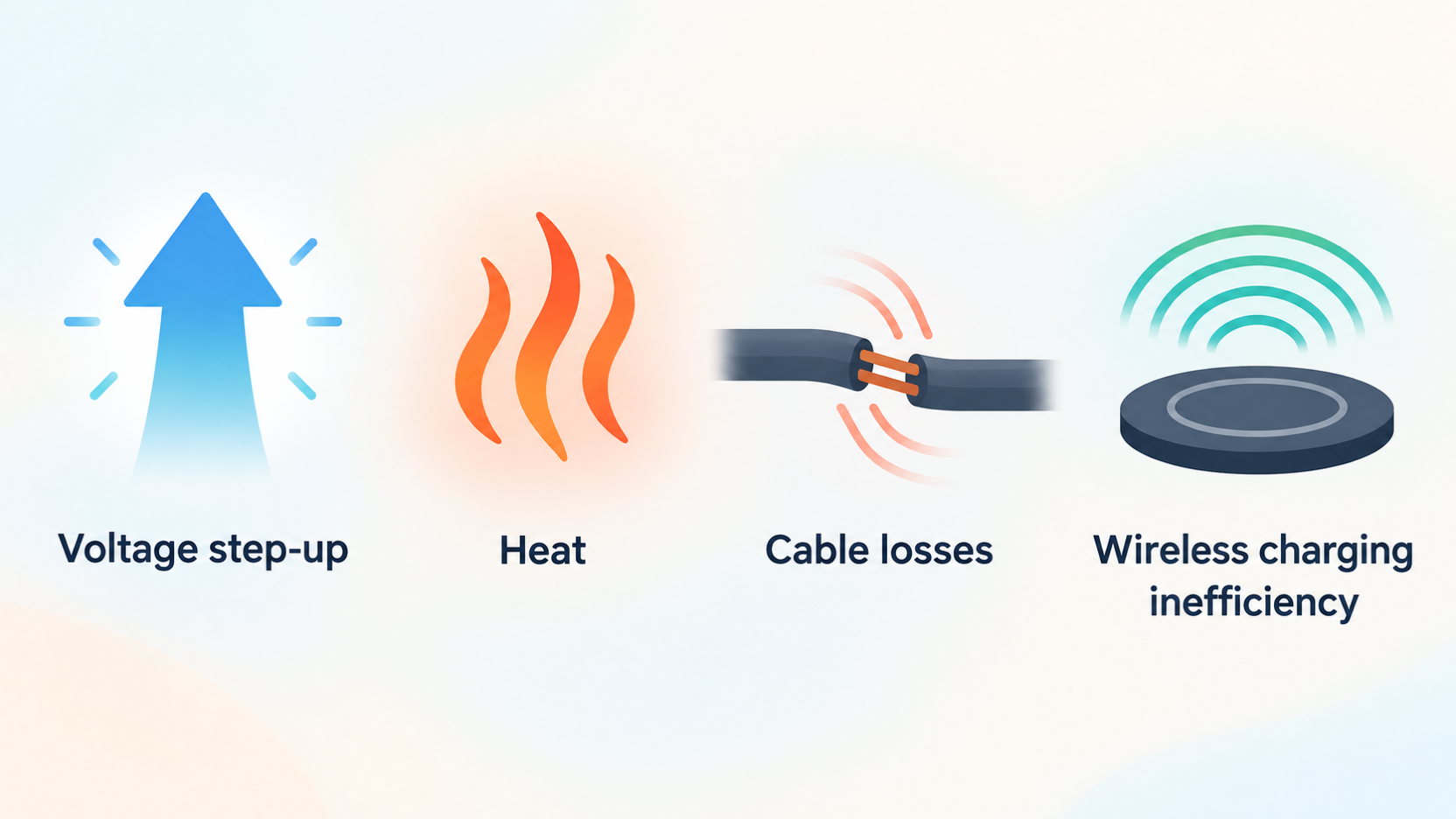
AI-generated generic editorial illustration — not a retailer product photo and does not depict the reviewed product or service. One row of icons with short labels showing the sources of conversion loss the section explains.
Even a correctly converted Wh figure is not what reaches your phone. Belkin's own buying guide says a 10K power bank is enough to recharge an iPhone 14 one and a half times, or to charge a phone and accessories such as headphones at the same time. That is noticeably fewer charges than a naive division of capacities might suggest.
The following is general explanation rather than our own measurement. Energy is stored in the power bank's cells at a lower voltage and has to be converted to the USB output your phone expects. Some energy is lost along the way, typically as heat. Cables add further resistance. Wireless and magnetic charging is generally less efficient than a cable, because energy is lost in the gap between the two coils. The exact losses vary by product, so we do not quote an efficiency percentage.
There is one more practical effect. Belkin notes that if you charge a connected device while the power bank itself is recharging, the bank takes longer to recharge. If you rely on overnight top-ups, avoid drawing power from it at the same time.
The sensible way to plan is to treat the label capacity as an upper limit. Expect fewer full phone charges than the headline mAh suggests, and use Belkin's one-and-a-half-charges example for a 10K bank as a realistic anchor. This guide is based on published specifications and does not include our own efficiency tests.
Where 10000mAh and 20000mAh power banks fit
Belkin positions a 10K power bank for a single phone plus accessories such as headphones, and a 10K or 20K bank for a set of headphones or two phones. If you also need to charge tablets or laptops, it says you will want higher wattage, which is about output, not just capacity.
Anker's power bank range is filtered by capacity bands: under 10,000mAh, 10,000–21,000mAh and over 21,000mAh. It also filters by features such as Power Delivery (PD), magnetic and MagSafe-style attachment, pocket size and built-in cables. Its listings include a slim 10K magnetic model and a laptop-class model with high-wattage output and built-in retractable cables, which shows how capacity and output are treated as separate choices.
CNET's iPhone power bank roundup highlights slim magnetic and 10,000mAh options, and it lists power capacity versus weight as a trade-off to consider. In general terms:
- Around 10,000mAh: easier to carry and enough for a phone plus an accessory, in line with Belkin's description.
- Around 20,000mAh: more reserve for two phones or longer trips between recharges, at the cost of extra weight.
- Extra features: magnetic attachment, built-in cables and a slim profile can suit daily carry, but they add to the checklist rather than replacing the basics.
We describe features here rather than ranking products. Which tier suits you depends on how often you can recharge and what you carry.
Matching capacity to your phone, tablet or laptop
Capacity alone is not enough. Belkin says tablets and laptops need a power bank with a higher wattage, so check output as well as mAh. It also says USB-C Power Delivery (PD) support means a power bank charges and recharges faster than one without it.
Connectors matter too. CNET notes that from the iPhone 15 onward Apple moved from Lightning to USB-C, so some people still have a Lightning iPhone while others have USB-C. Check which cable your device uses before you buy a bank with a built-in cable.
| Your situation | Capacity tier to consider | What else to check |
|---|---|---|
| One phone on a day trip | Around 10,000mAh | A slim or magnetic model if your phone supports it; USB-C or Lightning to match your device |
| Phone plus headphones | Around 10,000mAh | Number of ports, so both can charge together |
| Two phones or a weekend away | 10,000–20,000mAh | Weight, and whether PD speeds up recharging the bank |
| Tablet | Check output wattage first | The tablet's charging wattage on its manufacturer spec page |
| Laptop or remote work | Laptop-class bank with high-wattage output | The laptop's charging wattage and whether the bank has built-in cables |
We have not listed wattage figures in the table because they depend on your device. Look up the charging wattage on your phone, tablet or laptop manufacturer's spec page and make sure the power bank's rated output meets it. For magnetic charging, check that the bank's wireless standard matches your phone's, as CNET discusses MagSafe and Qi2 as separate considerations.
Airline carry-on rules for lithium power banks
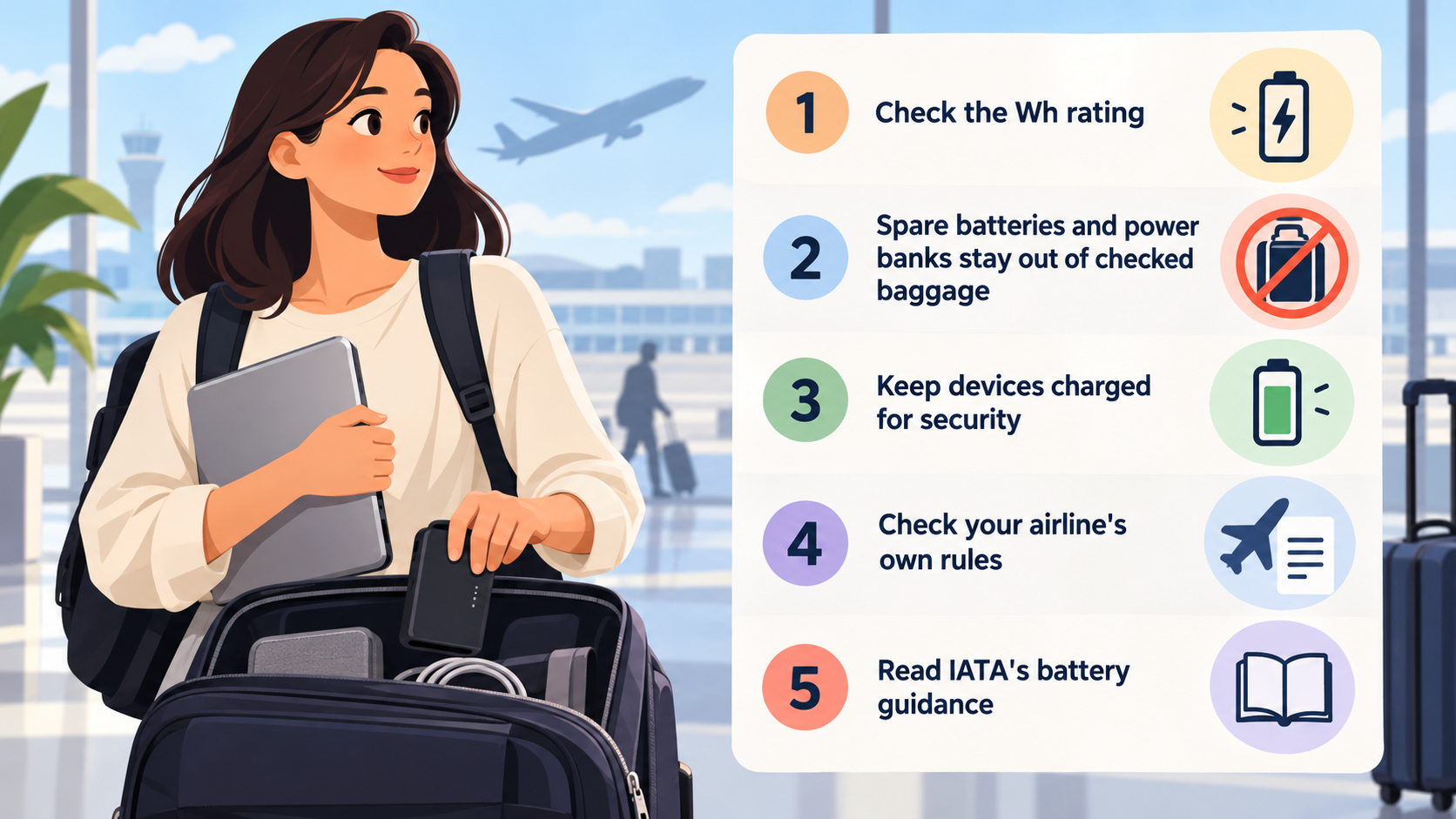
AI-generated generic editorial illustration — not a retailer product photo and does not depict the reviewed product or service. Numbered checklist of the carry-on points the section states from official aviation sources.
The official sources support a few clear points.
- Wh rating matters. IATA says lithium batteries can be carried by air depending on configuration and Watt-hour rating for rechargeable batteries.
- No spares in the hold. IATA states spare batteries are not allowed in checked baggage. Power banks are spare batteries, so keep them in your hand luggage.
- Charge your devices. GOV.UK says electronic devices must be charged before you travel, and a device that does not switch on when requested will not be allowed on the aircraft.
- Airlines may differ. GOV.UK says some airlines have different restrictions and advises checking battery restrictions with your airline if you are not sure.
- Read the guidance. IATA publishes a Battery Guidance Document. Its 2025 edition references the 66th edition of the Dangerous Goods Regulations and now covers sodium-ion batteries as well, so check that you are reading the current edition.
We do not state specific Wh thresholds or airline approval requirements here. The supplied official pages point to the IATA guidance document and your airline for those details, and limits can change. Confirm the numbers there before you travel.
To check your own power bank, convert it as shown earlier. For example, a 20,000mAh bank at an assumed 3.7V comes to about 74Wh. Then compare that figure, or better still the Wh printed on the product, with the limit in IATA's guidance and your airline's policy. This is your own check, not a ruling that any particular product is allowed.
Reading labels, specs and warranty before you buy
Before you trust a capacity claim, check these points on the box or spec page:
- Wh on the label. A printed Wh figure is more useful than mAh, especially for travel.
- Rated output wattage. Make sure it covers your phone, tablet or laptop.
- Port types. USB-C, USB-A and any built-in cables should match your devices.
- Compliance marks. Belkin advises buying from a reputable brand that clearly displays compliance markings such as CE and UKCA.
- Warranty and returns. Anker's page advertises a warranty, a 30-day money-back guarantee and certified compatibility. These are manufacturer claims, so read the terms rather than treating them as verified outcomes.
A note on how this guide was put together. It draws on official manufacturer and aviation pages, GOV.UK, and independent editorial context. It does not involve personal hands-on testing. CNET's roundup was updated in July 2026 and describes its own testing, and we cite it as editorial context rather than as lab proof for our conclusions.
Source freshness varies. Belkin's buying page references 2023, and IATA's guidance refers to the 66th edition of its regulations, so check current product specifications and the latest aviation guidance before you spend money or pack your bag.
Frequently Asked Questions
How many times can a 10,000mAh power bank charge my phone?
It depends on the phone and on conversion losses. Belkin's example is that a 10K power bank gives enough power to recharge an iPhone 14 one and a half times, or a phone and accessories such as headphones at once. Treat that as a realistic guide rather than expecting a full division of capacities.
Why does my power bank's mAh rating not match the mAh of my phone battery?
The voltage figures behind the two ratings can differ, and energy is lost converting stored power to USB output. Comparing watt-hours is fairer, and even then you should expect fewer full charges than the maths suggests. See the sections on converting mAh and on real-world losses.
Can I put a power bank in checked luggage?
No. IATA states that spare batteries are not allowed in checked baggage, so keep power banks in your hand luggage. GOV.UK also advises checking battery restrictions with your airline, since some airlines have different rules.
How do I convert mAh to watt-hours for an airline check?
Multiply the mAh rating by the nominal cell voltage, then divide by 1,000. With an assumed 3.7V, a 10,000mAh bank is about 37Wh. If the product prints a Wh figure, use that. Then compare it with the limits in IATA's guidance and your airline's policy.
Does wireless or magnetic charging use up a power bank faster?
Generally, yes. Wireless and magnetic charging is usually less efficient than a cable, so more of the stored energy is lost along the way. We have not measured this ourselves, and the effect varies by product.
Sources
Related reading
- Best USB-C power banks for everyday carry: evidence-led top choices
- Samsung chargers and power accessories review: practical buying assessment
- How to choose a USB-C charger: wattage, ports and safety
- When to buy chargers and power banks for better value
Editorial information: About our editorial team · Read our editorial policy · Read our affiliate disclosure.