
The Short Verdict
AI-generated generic editorial illustration — not a retailer product photo and does not depict the reviewed product or service. Editorial illustration supporting this section.
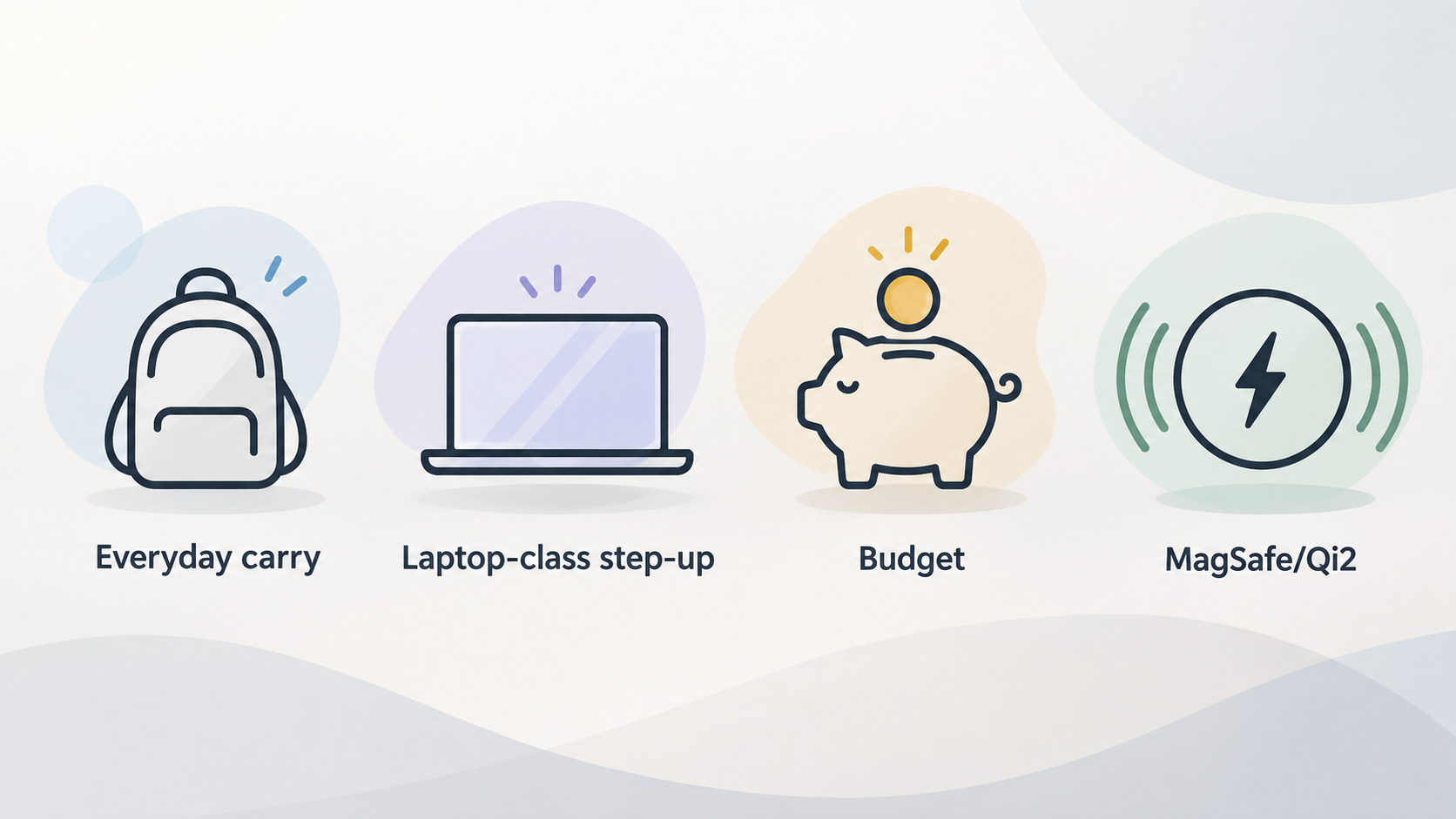
For most people, the best everyday-carry USB-C power bank is a 10,000mAh-class unit with at least one USB-C Power Delivery (PD) port that is light enough to forget in a bag. Belkin's buying guidance calls a 10K bank "a safe bet", good for roughly one and a half iPhone 14 charges, or a phone plus accessories such as earbuds.
- Everyday carry: a 10K-class USB-C PD bank. Independent roundups lean towards Anker. Expert Reviews names the Anker Prime A110A best overall, and Wired names the Anker Laptop Power Bank best overall.
- Laptop-class step-up: the Anker Laptop Power Bank. It has 25,000mAh and delivers up to 165W across two devices, or 100W to a single USB-C device. Wired picks it as best overall, and Expert Reviews picks it as best for air travel.
- Budget: the Cuktech 10 Mini, which Expert Reviews names its best cheap power bank.
- Magnetic (MagSafe/Qi2): the Anker MagGo Power Bank 10K (Qi2), which Wired names its best MagSafe/Qi2 portable charger.
Confidence varies by brand. Anker has the strongest evidence here: an official collection page plus two independent roundups. For Belkin we have only general buying guidance. For Samsung we have only an accessories hub. Any recommendation for those two brands is conditional and flagged below.
This is editorial synthesis, not hands-on testing. We did not test any of these products. The verdicts rest on published specifications, official brand pages and the judgements of independent reviewers.
What Everyday Carry Means for a USB-C Power Bank
AI-generated generic editorial illustration — not a retailer product photo and does not depict the reviewed product or service. One row of five icons with short labels for the five specs the section defines, so readers know what to check on any power bank.
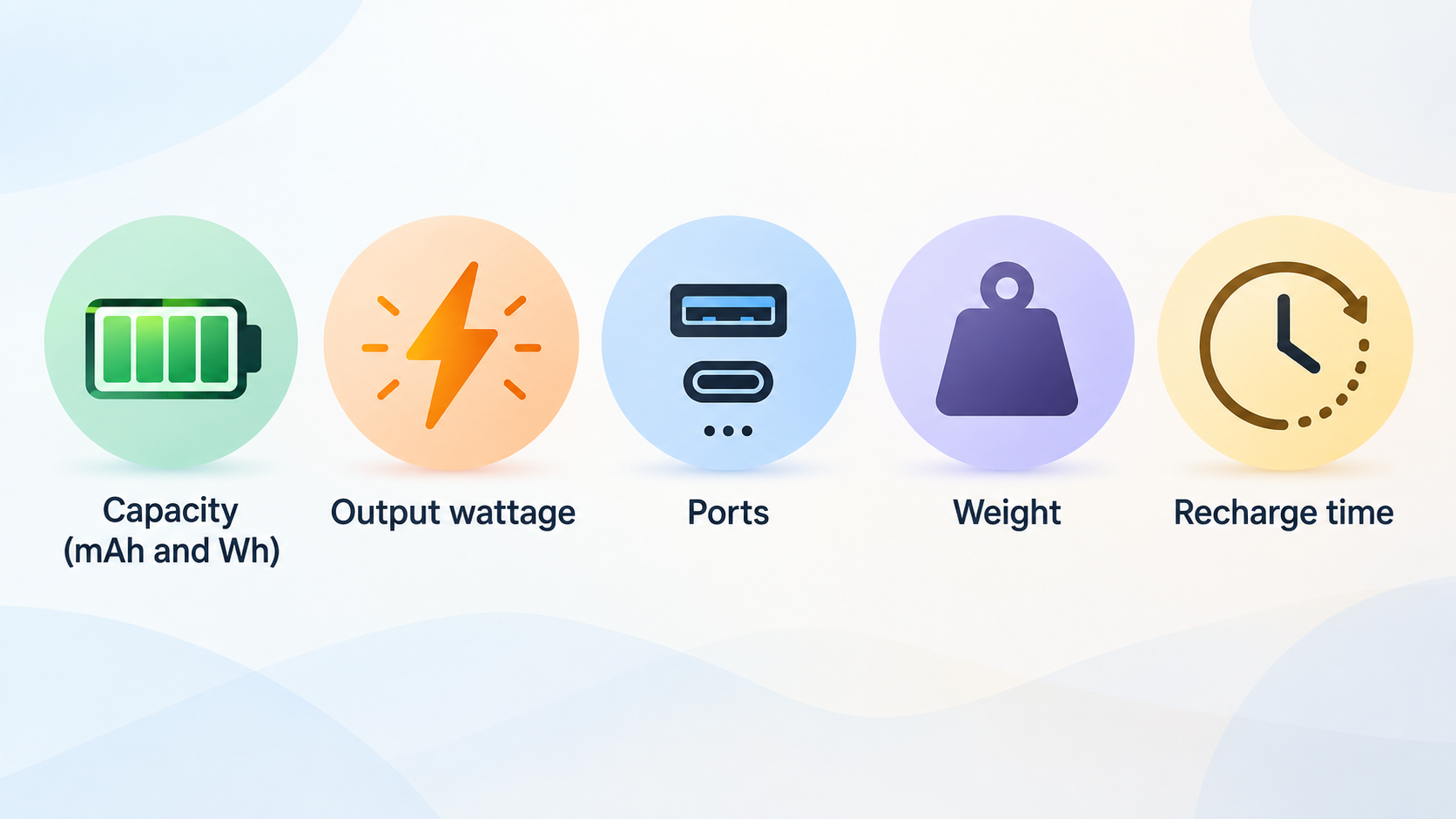
Five specifications decide whether a power bank suits daily carry.
- Capacity. This is quoted in mAh. Belkin says the most common sizes are 10,000 and 20,000.
- Output wattage. Phones need far less power than tablets and laptops. Higher wattage matters mainly if you charge the bigger devices.
- Ports. You want at least one USB-C port. Some banks add a built-in cable, which is one less thing to carry.
- Weight. Capacity and weight trade off directly. CNET frames this as "power capacity vs weight".
- Recharge time. Belkin says USB-C PD charges and recharges faster than a bank without it. Charging a device while the bank itself recharges makes the wait longer.
Converting mAh to watt-hours
Watt-hours (Wh) are a better yardstick for comparing banks and for checking airline limits. Most manufacturers quote mAh at a nominal cell voltage of about 3.6 to 3.7V. Multiply mAh by that voltage and divide by 1,000.
- 10,000mAh works out at roughly 36 to 37Wh.
- 25,000mAh works out at roughly 90Wh.
These are our derived estimates, not manufacturer-stated figures, unless a spec sheet gives its own Wh number. Real-world usable capacity is lower than the rated figure because of conversion losses, so treat the numbers as ceilings.
Anker's own product filters show how the market is split. They cover capacity bands (under 10,000mAh, 10,000 to 21,000mAh, over 21,000mAh), charging-speed bands, and features such as PD, pocket-size, MagSafe and magnetic, and built-in cable.
How This Guide Was Built and What the Evidence Can Support
AI-generated generic editorial illustration — not a retailer product photo and does not depict the reviewed product or service. A short numbered checklist of the three kinds of sources behind the guide, making the method and its limits transparent.
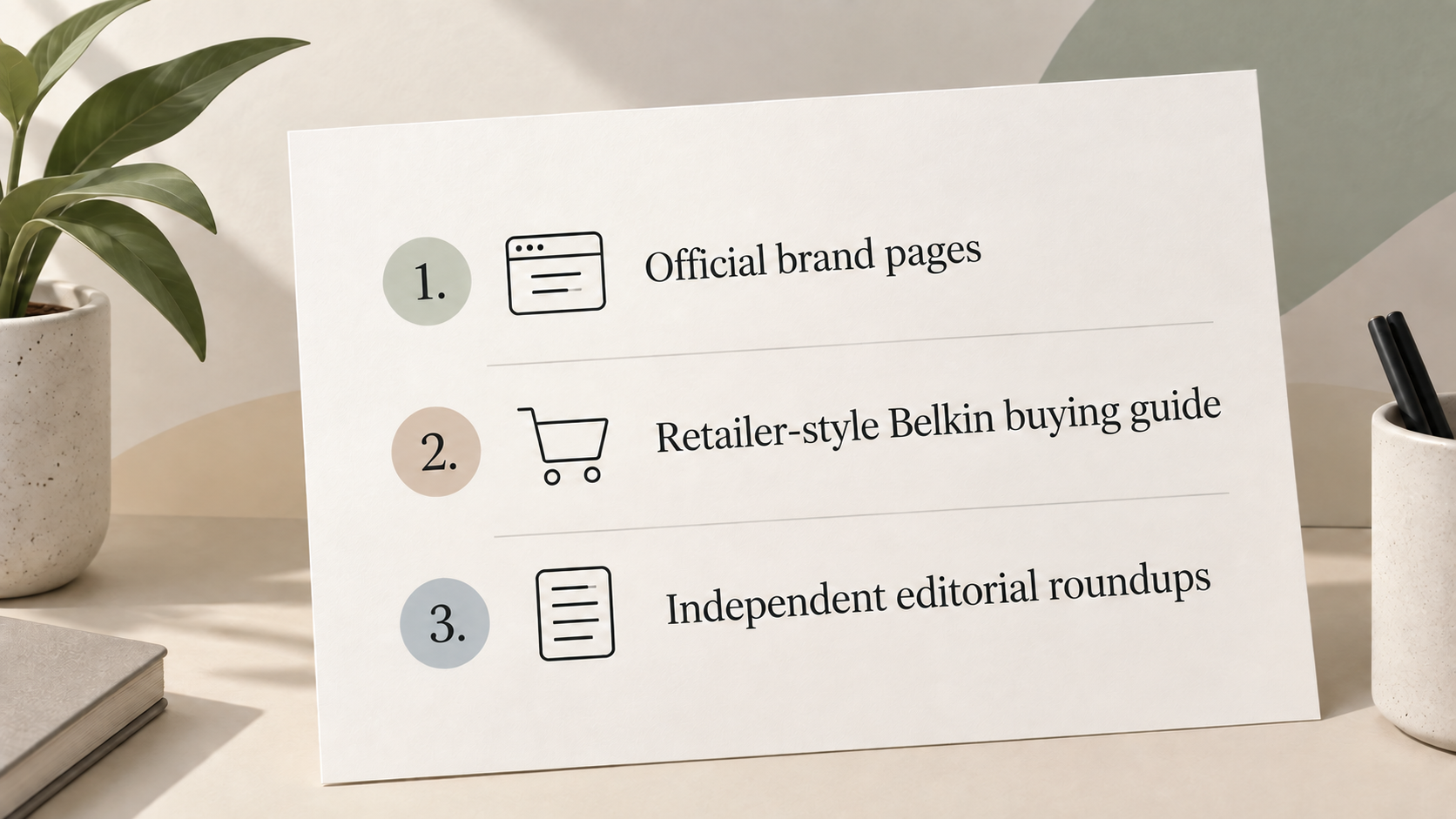
The guide draws on three kinds of source.
- Official brand pages: Anker's power bank collection, Belkin's power bank buying guide and Samsung UK's mobile accessories hub.
- A retailer-style buying guide: Belkin's, which is a brand page with a sales purpose.
- Independent editorial roundups: Expert Reviews (updated 10 July 2026), Wired (updated July 2026), CNET (updated 30 July 2026) and Tom's Guide.
The limits matter.
- Belkin's guide is framed around 2023 and the iPhone 14. It is used for principles such as capacity, PD and safety marks, not for current product claims.
- The Samsung page is a category hub with no usable power bank specifications, so no Samsung spec is asserted.
- Rankings from Expert Reviews, Wired, CNET and Tom's Guide are the testers' judgements, not measurements made for this guide.
- Reliable weight and recharge-time figures are not present in the evidence gathered. Check them on each product page.
- Expert Reviews says it may earn a commission on purchases made through its links. Treat that as context when reading any roundup.
The Everyday-Carry Shortlist
Each pick below has a "best for" tag, a note on how well the specs are evidenced, and a caveat.
Anker Prime A110A
- Best for: buyers who want the pick Expert Reviews calls the best power bank overall.
- Spec confidence: low. Our evidence gives the ranking but not the capacity or output figures, so confirm them on Anker's page.
- Caveat: a single outlet's top pick. Wired does not rank it first.
Anker Laptop Power Bank (A1695)
- Best for: laptop carriers and frequent flyers.
- What the sources say: Wired lists 25,000mAh, up to 165W to two devices and 100W to a single USB-C device. It also lists a retractable flat 2.3ft USB-C cable and a braided 1ft USB-C cable. Expert Reviews names it best for air travel.
- Spec confidence: good for capacity and wattage.
- Caveat: at this capacity it is a poor fit for light pocket carry.
Anker MagGo Power Bank 10K (Qi2)
- Best for: people who want magnetic wireless top-ups in a slim format.
- What the sources say: Wired names it its best MagSafe/Qi2 pick. Anker lists a slim MagGo 10K as a best seller.
- Spec confidence: moderate for capacity, and wattage and weight need checking.
- Caveat: wireless charging is usually less efficient than a cable.
Cuktech 10 Mini
- Best for: budget buyers. Expert Reviews names it its best cheap power bank and describes it as pint-sized and good value.
- Spec confidence: low. The evidence gives the ranking but not the figures. The name suggests a 10K-class unit, but confirm that.
- Caveat: a less familiar brand, so check the warranty and compliance marks before buying.
Belkin
Belkin's official guidance supports 10K and 20K sizes and advises checking for CE and UKCA compliance marks. We have no evidence on specific current Belkin models, so we do not recommend one.
Samsung
The only Samsung evidence is an accessories hub that lists a Chargers category. Samsung is a verify-before-buying brand, not a ranked pick.
Spec Comparison: Capacity, Wattage, Ports, Weight and Recharge Time
Estimated Wh is our derived figure (mAh × about 3.6 to 3.7V ÷ 1,000). Where the evidence is silent, the cell says so rather than guessing.
| Model | Rated mAh | Est. Wh (derived) | Max output | Ports | Weight | Recharge time | Confidence |
|---|---|---|---|---|---|---|---|
| Anker Laptop Power Bank | 25,000 | about 90 | 165W combined, 100W single USB-C | USB-C, plus built-in retractable and braided USB-C cables | Check product page | Check product page | Good for capacity and wattage |
| Anker MagGo 10K (Qi2) | 10,000 | about 37 | Check product page | Check product page | Check product page | Check product page | Moderate |
| Cuktech 10 Mini | Not stated in our evidence | Not derived | Check product page | Check product page | Check product page | Check product page | Low |
| Anker Prime A110A | Not stated in our evidence | Not derived | Check product page | Check product page | Check product page | Check product page | Low (ranking only) |
Two points follow from the table.
- Capacity against weight. More Wh means more bulk. This is CNET's "power capacity vs weight" framing, and it is the central trade-off in this category.
- Recharge time. A bank with PD input recharges faster, but charging devices at the same time lengthens the wait (Belkin).
Where the Top Picks Are Strongest
Breadth of range. Anker's collection runs from under 10,000mAh to over 21,000mAh. Its filters cover PD, pocket-size, built-in cable and MagSafe/magnetic options, so one brand covers most of the profiles in this guide.
Built-in cables. A retractable cable, as on the Anker Laptop Power Bank, removes one more thing to carry.
Multi-device output. A 100W-class USB-C port lets one bank charge a phone and a laptop. Wired and Expert Reviews both value this.
Support and warranty. Anker's collection page advertises a 30-day money-back guarantee and a hassle-free warranty. Confirm the terms at the point of purchase.
Independent agreement. Expert Reviews and Wired both put Anker products at the top of their lists. They choose different models, but the brand-level agreement is useful.
Safety signals. Belkin's guidance stresses buying from a reputable brand that displays CE and UKCA marks. That applies whichever brand you choose.
Limitations and Trade-Offs to Weigh
AI-generated generic editorial illustration — not a retailer product photo and does not depict the reviewed product or service. A numbered checklist of the trade-offs to weigh before buying, matching the points the limitations section states.
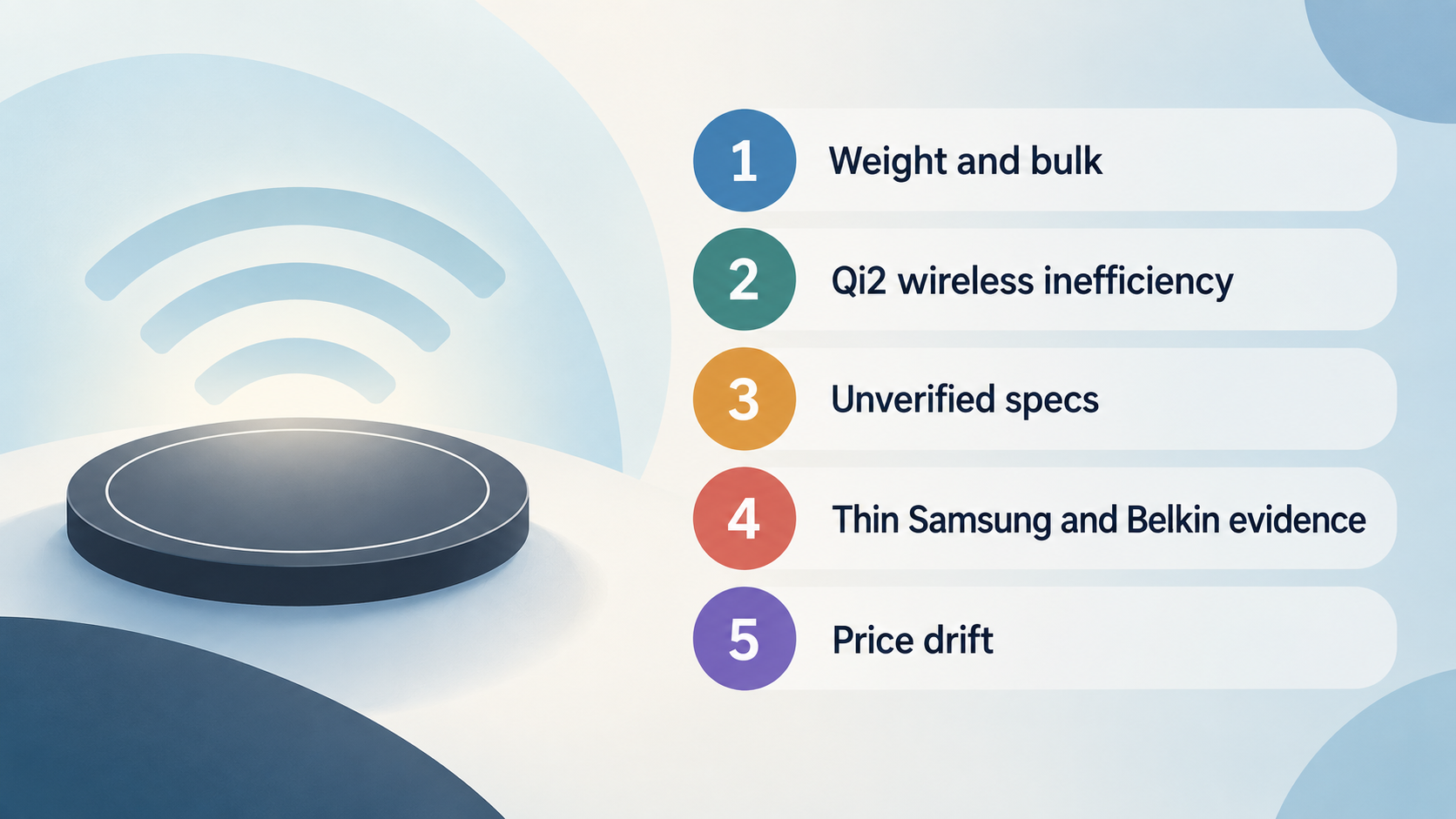
- Weight and bulk. A 25,000mAh laptop bank is heavier and bulkier than a 10K model, so it is a poor choice for light daily pocket carry.
- Magnetic wireless charging. It is convenient but typically slower and less efficient than a cable. This is general guidance, not a measurement of ours.
- Unverified specs. Our sources give no verified weight or recharge-time data, and no Samsung power bank specs at all.
- Thin Samsung and Belkin evidence. Belkin's guidance is dated around 2023 and the iPhone 14. Samsung is an accessories hub only.
- Price drift and affiliate links. Prices and rankings change, and the roundups were updated in July 2026, so recheck before buying. Expert Reviews discloses that it may earn a commission, so read rankings alongside official specs.
One compatibility note: CNET points out that iPhones before the iPhone 15 use Lightning. Owners of those phones may need a Lightning cable or a bank designed for it.
Alternatives Worth Considering
If the main shortlist does not fit, the same roundups name other options.
- Expert Reviews: the UGreen Nexode PB771 for charging multiple devices, and the Iniu SnapGo Air as its best MagSafe wireless pick.
- Wired: the Nimble Champ (Series 2) as best smaller power bank, and the Sharge Shargeek 170 as best-looking.
- CNET: its iPhone roundup includes slim Qi2 magnetic banks, banks with a built-in USB-C cable and earbud cases with a battery built in.
- Tom's Guide: groups picks by best overall, budget, travel, most pocketable, big-capacity MagSafe and camping.
- Samsung: the accessories hub lists Chargers, so Galaxy owners can check Samsung's own range. We have no evidence of Samsung power bank specifications.
If you only need a top-up at a desk, a compact wall charger may serve you better than a power bank.
Which Power Bank Fits Your Day
- Phone and earbuds only: a 10K-class bank with one PD USB-C port, in line with Belkin's guidance.
- iPhone owners: the iPhone 15 and later use USB-C. Older iPhones use Lightning (CNET).
- Galaxy and other USB-C phones: the same 10K-class advice applies.
- Tablet users: look for higher wattage and a PD port.
- Laptop commuters: you need around 100W single-port output or more, as with Anker's 165W bank (Wired).
- Frequent flyers: check your airline's Wh limit. Use our derived Wh as a pre-check, then confirm against the manufacturer's stated Wh.
- Everyone: choose a reputable brand with CE and UKCA marks and a clear warranty (Belkin, Anker).
Frequently Asked Questions
How many phone charges does a 10,000mAh power bank give?
Belkin says a 10K power bank gives roughly one and a half iPhone 14 charges. That is a rated figure. Real-world results are lower because of conversion losses.
How do I convert mAh to watt-hours, and why does it matter for flying?
Multiply mAh by about 3.6 to 3.7V, then divide by 1,000. So 10,000mAh is roughly 36 to 37Wh and 25,000mAh is roughly 90Wh. This is an estimate. Airlines set limits in Wh, so confirm the rules with your airline and the Wh figure with the manufacturer. Expert Reviews names the Anker Laptop Power Bank as best for air travel.
Is a 100W USB-C power bank necessary for a phone?
No. Higher wattage matters mainly for tablets and laptops, and phones need far less (Belkin). A 100W-class bank is for laptop carriers, such as Anker's 165W model with 100W on a single USB-C port.
Can I trust Samsung or Belkin power banks, and where do I check their specs?
We have no evidence on specific Samsung or Belkin power bank models, so we cannot rank them. For Samsung, our evidence is an accessories hub, so check Samsung's UK site for specifications.
How long does a power bank take to recharge?
It depends on how empty the bank is and on the charger and cable you use. A bank with USB-C PD recharges faster than one without it. If you charge a device from the bank while recharging it, the wait is longer (Belkin). Our evidence has no reliable recharge-time figures, so check each product page.
Sources
- Official source
- Official source
- Official source
- Independent guidance
- Independent guidance
- Independent guidance
- Independent guidance
Related reading
- Anker vs Belkin chargers and power banks: which is the better fit
- Anker charging review: power banks and chargers, strengths, limits and alternatives
- Power bank capacity explained: mAh, watt-hours and real phone charges
- How to spot genuine charger and power bank deals
Editorial information: About our editorial team · Read our editorial policy · Read our affiliate disclosure.